Saturday, June 18, 2022


sundaey

by Kirsten Ihns
(Propeller Books, 2020) 

Reviewed by Eran Eads 


“There’s something to be said about not saying anything.” 

—Janet Jackson


“I know / I don’t know / that’s what I do know” 

—also Janet Jackson


Sans serif on the hard pink shell of the cover greets the reader of Kirsten Ihns’ debut poetry collection sundaey. The flamingo-milk-stained edges of the book are ostentatious and cube the rectangulation of the outer presentation; this dimensionality further brings it to life. I know, I know, a book, its cover… judging! But the performance of the color captivates like a robin’s egg.


Note: I know Ihns and attended the Iowa Writers’ Workshop with her. For the purposes of transparency and ethical behavior, that must be known.  I consider this to be a re-view versus a review, and I consider that distinction to not only allow but to explain my compulsion to write.


Perched in the “day,” a block text in limbo between the table of contents and numbered pages, “sun” then “daey” are presented. More of these block-text poems will emerge throughout the pages, almost migratory in their return back to meaning and with something small flitting in to disturb them. 


The introductory poem is “yes, hello.” It is a strange beginning. It is rattling to begin with a confirmed response. In my own rereadings, I gloss the first couplet then read “I was taken out to dance and click.” Here and throughout the book, Ihns boggles with her specificity. I want to laugh at it as a line. It feels like all it can be doing is humorous. The last two words stretch the sincerity of the entire line. This is later followed by “mostly, I like things I can find.” This seems to be a crucial creation method for Ihns, her ability to listen and find, yet before the line can even end it plunges back into “by means of batherwater / behavior.” With the turn, she is no longer nest-collecting an identity but bobbing in bathwater to find. What bird is this?


The “i have left The Amazing Hair Day, for you” first line of the second poem, “the world of flying motor objects,” is instantly humanoid and shifts with the following lines into a demand. It is lyric, it is appealing, and it is “v” self-aware. However, it is not self-identifying. Much of the collection is self-aware and even alights momentarily near self-conscious. In “of the five senses, desire is the sixth,” the creature-speaker acknowledges creatureness but admits “sometimes it’s hard to know one is.” Yes.     


Sometimes the poems preen and carefully tumble line by line, but mostly they dart around as if trapped in/on the cage/page. Line uniformity seems to scare the speaker; it is avoided. In its place, sound is prioritized. Sometimes words seem to only exist because of their sound. Each a careful tweet (and often tweetable) moment that builds into song. Then “lol wat.”


The warble of the longer forms, while grounding the sometimes-flighty collection, blends seamlessly into the smaller chirping one-page poems that are sonically strongest. These poems are “the kind of pleasure you can gnaw and not diminish,” and it is often difficult to differentiate between their playful sensuality and their playfulness. Each so wholly convinces the reader to get caught up in the rapture of their sound.


Speaking of “rapture,” after a book-length deluge of good and great poetry, this poem is something beyond. It is a spectacular poem that I still find surprising three years after its publication (originally online in BOAAT). A person could spend years with this poem. I did. I will continue to. Each time I teach it, students are marveled by its seeming simplicity and eventual density. And the last three lines! After experiencing “rapture,” one can return to the page before page one and see in block text of “day” a door of “sun” and “dae.” This is what the book is, “a new door” leading to “the same building / as the others.” It’s a bird’s-eye-view of the door and it is also an invitation inside.


There are moments to openly chortle: I don’t know how to read the title “quat swan” and not laugh. That is the grammar of Ihns’ debut. And by “quat swan” it is all beginning to be a language of its own, understandable when one follows the flight. Then the Greek mythological figure Leda appears in the poem, or actually, the speaker commands the reader not to be “reading that in.” The repetitive negative command is a trick to the human mind and a confirmation that one should “reference to leda in the swan” regardless of what the speaker says. Again specificity turns the entire myth on its head with the replacement of “and” with “in.” As if Yeats’ sonnet needed further complications, Ihns steps in and complicates. This poem begins by engaging in hilarity and sacrificing then resurrecting the swan “on the lawn / like geese.”


This is the part where the ruse of the lyric-rouged lines begins to truly glimmer through. The speaker seems most “honest” as a bird, as a creature, as anything that is not human. Even inanimate objects have believable sentience in her lines.


The eye feathers of I-statements are a wonderful vehicle to guide the reader along a carefully curated flight path. Any other thing with eyes knows how to follow. When lines like “i refuge like my body is adornment” come it is both definitely contrived and certainly sincere. Then there are  lines that are a way for the reader to “fix it how you like it,” although this writer cedes no control.


A desperate bird will lure predators away from a nest with hopping and singing—any successful distraction. In this debut, Ihns is birdlike, though her distraction-song is not desperate, but consciously useful. By the end, a reader may be encouraged to lean away from trusting her “I.” The lyric continues to appear on the page but it is mostly pecked to near-death, cannibalized to serve the sound of each line. Trusting the musicality of the Ihns' lines is far more successful.


Out of the pink shell of sundaey hatches a knowledgeable bird: capable of human imitation like a crow, yet tropically showy. Even when contemporary means a time and not the now we know it, Ihns will never be accused of writing contemporary poetry. Instead she offers sundaey, “a new door,” a novel method for meaning makers to experience the strange.


What does it all mean? Sometimes it’s warning. Sometimes mourning. Sometimes it’s a playful morning tune. Most of the time it flutters between f**king and I-don’t-f**king-get-it. In that fluttering, the music of the verse remains undeniable. This is a strong first collection and an important debut. 

Friday, June 17, 2022


Scale Model of a Country at Dawn

by John Sibley Williams
(Cider Press Review, 2022) 

Reviewed by Linda Scheller 


The landscape of loss is a personal topography we traverse when those who are dear to us die. In his new book of poetry, Scale Model of a Country at Dawn, John Sibley Williams contemplates loss and its aftermath in poems that depict life’s evanescence and beauty with clarity and grace. Winner of the 2020 Cider Press Review Book Award, this collection offers nuanced perspectives on mortality that suggested to me a glass paperweight containing a microcosm. The reader encounters the crumbling houses of childhood, dark forests, a cliff, burning barns, the “multi-colored living field,” islands. These archetypal landmarks effectively connect the speaker’s experiences with memories and emotions from the reader’s own life.


Scale Model of a Country at Dawn opens with “The Gift,” a prologue in which the speaker pledges to make and give “something the light must struggle to enter.” Throughout the book there are allusions to profound losses in a muted elegiac tone. Williams’ studied restraint creates enigmas of loss so that reading the poems is akin to unearthing the bones that once comprised a body’s architecture, or smelling the smoke that lingers after fire. Carefully placed hints snagged my attention, and I felt compelled to read and then reread the entire book to better understand these losses and their ramifications.


The book’s eponymous poem begins with an epigraph defining a Hobson’s choice, the decision to accept or refuse the one thing offered. Time offers the quintessential Hobson’s choice: move forward or not at all. The only possible way to return to the past is through memory, a model of dubious verisimilitude by virtue of limited perspective and emotional refraction. It is important to note the time chosen for regarding this model of the past, since dawn implies the rebirth of hope, perhaps even joy, as the world of light, color, and clarity returns following a period of darkness.


The title poem consists of unrhymed couplets, the form Williams uses in the book’s first and last poem and in almost one-third of the collection. Enjambment spills images over lines and across the spaces between stanzas in a cleaving that severs, then connects thought: 


Either side of a saw, either a beheaded mountain

or not enough coal to last the winter; a startled


horse beats itself against an open barn door,

imitating flight, while the hay catches fire, &


emptied of organs, painted to look less still,

my mother has never looked more herself.


After a parent, caregiver, or another person integral to one’s life dies, memories and unanswered questions are likely to become focal points in which the relationship’s dynamics as well as the survivor’s self-regard are scrutinized. Scale Model of a Country at Dawn conveys these struggles and complicated emotions with admirable honesty. These beginning lines from “Controlled Burn” convey dread and doubt with ominous imagery and terse analogies:


Acre after acre left unburnt.

Full families of wolves gone

unshot. & the chickens we keep

to teach our children where meat

comes from are getting nervous.

The wire-thin pen cannot stop

the world from entering. Like how

quitting cigarettes only delays

a mother’s cancer. Like all those

desperate prayers that refuse

to restrain night.


Williams employs an ampersand in place of the word “and” even at the beginning of an utterance that culminates in a full stop, as seen in the excerpt above. The use of a symbol to represent this conjunction echoes the poet’s skill at weaving symbolic meaning into myriad images of animals, objects, and geographic features. There is, however, one poem about two-thirds of the way through the book that didn’t have ampersands nor the double slashes that appear in some other poems. The switch to formality gave me pause. I was curious to know the reason behind this choice, and the change caused me to slow down and read more carefully. “Fever” begins: 


When you hold your child’s body like this,

cold as unexcavated earth, wet with want,


making oaths to anything that will listen, please

and god and the usual silences, so much useless


splendor cradled fetally between raw open hands.

When the field just keeps going without you. 


The poem is stunning in its heartbreaking vulnerability. Of all the memories considered in this collection, the formality in this particular poem bespeaks exceptional anguish. As Emily Dickinson wrote, “After great pain, a formal feeling comes—” The frame of reference in “Fever” may well be, in Dickinson’s words, “the Hour of Lead— / Remembered, if outlived.”


The terror and shame in “Fever” are associated with “dark steepled night” and “gut-shot worship.” Left with “the usual silences” after a terrible event or devastating loss, even the most stalwart believers might well question their convictions. Certainly I did with the death of my grandmother, and then decades later when I lost my father and youngest brother. The poems in Scale Model of a Country at Dawn alluding to death and doubt resonated. Williams conveys the anguish of loss and the memory of trauma with extraordinary sensitivity. As I read these poems, I felt an empathic kinship with the speaker whose experiences of loss and doubt were superimposed on my own. 


The contemplation of one’s own mortality is given vivid evocation in “Synonyms for Paradise,” a poem near the beginning of the book. Williams writes:


It hurts me to do it, but let’s let the synonyms


for joy & for grief bleed together, like salt

& fresh water, like poles of a magnet.

That we all die before we’re finished

is no excuse to abandon this worn-out


car by the side of some nameless road,

flipped over, only partially on fire.

That we should know when we see it

is not the same thing as a promise.


The stark truth “we all die before we’re finished” is followed by a whimsical metaphor comparing life to an old car “flipped over, only partially on fire.” The dry humor conjured by that description never fails to make me smile, yet the next statement is a profound challenge. Within the poem and throughout the book, juxtaposed opposites like “joy” and “grief,” “salt,” and “fresh water” perfectly balance one another.


As in all the poems in this book, musical intonation carries the reader through “Parallax,” a gorgeous poem that combines the profound and the ordinary in shifting perspectives and indentation: 

     One could almost say


     illusion, that all this seeing

     is a trick the light plays to keep us


     rooted in place. In this case,

     driver, subject. If things worked out


     differently, we’d be out there wandering the object-heavy night


     dreaming that our raised thumb meant

     you can trust me & unarmed, then drinking

     the moon from crushed cans rusting by the road.


The last section of the book, “Object Permanence,” is notable for poems that seek resolution and find endurance in a considered acceptance. Tentative joy emerges from the ashes and regrets, and gradually the sharp outlines of loss begin to blur. The speaker regards his own children with wonder akin to breath caught in surprise and released in awe. In one of the book’s last poems, “Restoration,” we read:


In the absence of repair, I’ll make due

with telling my children this failing house

& the country we planted it in & the world

that refuses to stop blooming around us


& the stars can be shelter enough.


During our lifetime, each of us travels through our own little country with its own particular landscape. Yes, there is loss, but there is also love, beauty, and hope. As the poem “Larynx” proclaims, “the world is worth singing into.” In Scale Model of a Country at Dawn, John Sibley Williams urges us to savor the journey and cherish those with whom we travel. 


Thursday, June 16, 2022


Tidal Wave

by Dennis H. Lee
(Passager Books, 2020) 

Reviewed by Erica Goss 


Dennis H. Lee’s award-winning collection Tidal Wave opens with a quote from Captain Newman, M.D., Leo Rosten’s 1961 novel about a World-War-II-army psychiatrist. In the quote, a cynic, a mystic, and a “man who loved reason” are asked what they would do if the island they were on disappeared under a tidal wave. The cynic would indulge his carnal desires, the mystic would make sacrifices and pray, and the man who loved reason would immediately “study how to live under water.” Tidal Wave reflects all three attitudes, with poems that focus on humor, food, and above all, a pragmatic view of the past.


Beginning in early childhood, the poems in Tidal Wave follow the trajectory of a long, well-lived life. In the book’s first poem, “Coney Island–July 4, 1952,” a summer day unfolds, with carefully chosen details describing a comfortable if slightly cloying atmosphere: “Grandma’s beef smoke / oils the underside of leaves” and “chicken fat soaks into brown paper bags.” The poem’s last lines evoke summer’s appeal, as well as its torpor, as seen through the eyes of a child:


I sit on the fire escape with kosher chicken and comics.

Grandma speaks Yiddish into the soup.

Tonight’s sky will be brighter than the Ferris wheel.


These lines evoke childhood in a specific place at a specific time, and a way of life that no longer exists except in the fragments of memory. 


Tidal Wave is not especially nostalgic in tone—the poems don’t reveal an overriding longing for the past, nor do they romanticize it. Instead, they offer a glimpse into how memory operates, as in “Leaning in my tired seat.” As the speaker falls into a half-sleep while riding on a subway train, memories unspool from the present to the recent, and then the very distant past. In that half-awake, half-asleep state, he recalls a grandfather “dreaming of Russia, / of cows in a small fenced pasture along the road he walks carrying / eggs in a basket for his grandmother who had kind blue eyes. Sad, / but kind.” 

The rituals of preparing and consuming food play a major role in this book. In “Arpeggio,” Lee details the sensual qualities of bread:


I liked to tear clumps of challah

from the round braided pile of bread,

squinching the piece in my hand to help

leverage the tearing, then watch it 

slowly rise back to fluff.


The action of “squinching” the bread and watching it rise again is as important as eating it. In the poem, food and its savory delights open a floodgate of potent memories: malteds, bagels, and Maxwell House instant coffee, to which his grandmother added “three teaspoons of / sugar, then slowly poured in heavy cream / so I could watch it spiral and cloud its way down.” The poem reminds us that the taste, aroma, and texture of food have the power to bring back memories.


Eating is not always pleasurable, however. In “Lunch,” the speaker can’t find a group he feels comfortable with, “the accountants are talking baseball / … I don’t know sports,” “the secretaries / … know too much,” “the guys from the plant are too / down-to-earth … / They might just eat you.” The poem brings to mind the classic high school lunchroom scene where an unpopular kid searches for a group to sit with. Similarly, the anticipation of eating something delicious can quickly sour; in “The hand sanitizer at my new bar,” the penetrating odor of hand sanitizer ruins the flavor of peanuts: “my scotch won’t kill it. Not even / jalapeños.”


In “Eating Crab,” Lee compares reading the Bible to eating crab: “I have been tearing through the Bible, / looking for those morsels people / talk about.” The process of eating a crab, with its cracking and pulling meat from small cavities, is an apt metaphor for attempting to glean meaning from a dense and difficult text. As Lee writes about reading the Bible, “the little that reaches my mouth— / well, I’m not sure it’s worth the effort.” By the end of the poem, however, he’s found something that justifies that effort:


A few little strands, sweet and succulent,

and I draw them through my lips slowly,

savoring. My hands need washing.

I do not wear a bib. My plate

is filled with cracked discards.


Lee has an ear for the absurd, as in “My Doctor’s Dog,” which expounds on physicians having animals in their offices—a dog, a horse, chickens—following, presumably, the therapy-animal model intended to put their patients at ease. It has the opposite effect on the speaker, who objects to “slobber on the pen” or the way the doctor’s dog “sniffs all over my legs.” He concludes that he’ll need to start a program of “self-healing.” 


“Before you write from the heart” is an irreverent take on the gatekeepers of the literary world. In the poem, the speaker receives advice from an imaginary medical team. We quickly understand that they are editors posing as doctors:


          We will inject

a dye that…will show when you begin

writing from the heart and when you stop.


The patient has no choice but to agree with the findings, “which will have no effect on the content / of any subsequent rejection slips we send.”


Some of these poems veer into darker territory. In “On Dark Wings,” the speaker holds the hand of his dying wife; her impending death filters through the poem with his gradual comprehension. From the “anticipation / … of a vacation” to “her dead hand” with its “gold meaningless band,” the poem gathers itself into grief as it ends, with the speaker too stunned to “even ask the questions.”


In “The Blood Room,” a child observes a patient “knitting needles in your hands, / IV needles stuck into your flesh.” The child’s curiosity regarding the woman knitting is at odds with her shyness; the knitter stays focused on her craft. The poem captures the absurd yet somehow appropriate pairing of IV and knitting needles; the child’s reaction holds these elements together.


Looking back at experiences doesn’t always bring understanding. In the collection’s title poem, “Tidal Wave,” an event that occurred at a beloved lake still mystifies, even after so many years: “what looked like a wall / of water, a giant wave, was coming right at me.” Unprepared for this catastrophe, he simply reacts: “I / dropped my rod and ran for the hotel,” unlike the measured responses of the cynic, the mystic, and the man who loved reason. The poem also reminds us that age doesn’t necessarily lead to wisdom—sometimes reflection just intensifies the confusion.


Tidal Wave shows us how memories lie in wait, so often surfacing during moments when we are otherwise engaged. Accessible and straightforward, and imbued with a wry sense of humor, this book is the work of a poet who’s witnessed an enormous amount of change, and whose memories’ power and energy have not diminished.


Wednesday, June 15, 2022


The Thicket

by Kasey Jueds
(University of Pittsburgh Press, 2021) 

Reviewed by Katherine Indermaur  


Kasey Jueds’ second poetry collection brims with vivacious imagery that encompasses both the enchantment and danger presented by the mysterious natural world. I caught myself returning to the spells cast by these lyrical poems over and over, wanting to steep in this book’s verdant magic as much as fresh air. 

The landscape of The Thicket is one “where the deer / keep their secrets” as much as it is where “winter tenses its solitary muscle, and food // turns scarce.” Elements of the fable and fairytale recur, particularly in reference to the Grimm brothers’ “Little Briar Rose,” often retold now as “Sleeping Beauty.” Throughout the collection, the female speaker’s tender but insistent ethic emerges, one where “nothing at the edge of woods or fall / is meant to be untangled” and still “each softness is kin to the next.” For Jueds, the tangle of this world is what keeps us all looking, and when we are looking together, we can’t help but recognize kinship. 

Perhaps because we are thus implicated in the wilds of The Thicket, familiar spaces appear beyond any fairytale forest. Here, too, is the backyard—the landscaped neighborhood and city streets entangled with abandoned barns and reclaimed meadows. In “Love Poem with No Mountains in Sight,” Jueds writes:

                        A dog barks from streets away
and my heart casts itself past
the tender border her calling makes. As we
are always casting ourselves across edges
and streets, as I once stepped from a curb just when
the icon of the walking figure on the sign began
to pulse, and realized in that second that
I loved you. 

These are the places where we fall in love with one another, the places that hold our first loves and mark us for it. So, too, in “That Far North,” where the speaker breaks out into a rash after having kissed her lover while unknowingly brushing against poison ivy, and is “glad to have . . . / the fire she felt / pressing outward / to make itself known on skin.”  

For a speaker who aims to believe in this ethic she uncovers in the natural world’s profound and apparent entanglement, it is at first surprising how central a role distance plays in these poems. Many depict open spaces, which—while contributing to an abiding sense of calm throughout the work—are not without their difficulty. The speaker is often beckoning, hopeful, as in “The Far Field” (there’s “Far” again): “I could say I do not / know you, don’t understand // what listening I am calling / toward. And still. Come close.” These are places where deer approach close enough for us to note the sun through the translucent edges of their ears, but not close enough to touch. There exists a tension in The Thicket between distance and intimacy, perhaps most memorably depicted in “At Cape Henlopen,” where two lovers embark on a camping trip together:

                                              We walk in light
so steep I can see each single stitch
of your gray sweater, its hem and sleeve; see
for a moment how we’re knitted together
in the wind that keeps tearing us gently from our names.

It takes this distance and the sunlight between them for the speaker to recognize with awe her and her lover’s closeness. It is fitting, then, that Jueds never ultimately disentangles intimacy from distance. This tension is where the sensuality of The Thicket thrives, much like its namesake snarl whose shadow beckons while concealing the thorns we all know are there. 

Jueds also employs repetition toward this sensual effect across the book. A series of five “Litany” poems appear throughout, but Jueds doesn’t limit litany to this series alone. In “Not All the Winds Have Names,” every line begins with the word “body”: “Body of the deep north, the narrow road. / Body remembering: fox in the middle of the harrowed field in a linger of afternoon light.” Such anaphora opens up the realm of the poem to prayer, to magic spell, like the chant inside enchantment. With each iteration of “body,” the text reaches further beyond the page and toward real rhythm, real tongue. It labors to close that distance. 

When The Thicket is at its most lyrical and most pleasurable, it arrives at its most sensual, as in “Of Pink”:

                        You came late
to pink, though pink was always
here. The one who holds
your face in both hands. The one
who says I see you. Nothing silks so. 
Pink of oh. Pink of see-me.
Of labia and lip, of welts
raised by poison ivy on the tender
inlet of wrist.

Jueds has a fantastically skillful ear. Here she builds intimacy by layering vivid imagery atop fricative sound. The way the repeated sibilance in “who says I see you. Nothing silks so” tangles our tongues against our lips is not too far, after all, from any earnest tryst—just far enough for us to see the kinship, and yearn.


Tuesday, June 14, 2022


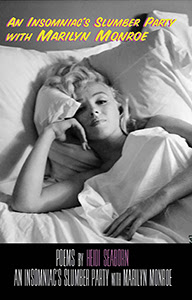
An Insomniac's Slumber Party with Marilyn Monroe

by Heidi Seaborn
(PANK Books, 2021) 

Reviewed by Mary Ellen Talley 


From the initial pages of An Insomniac’s Slumber Party with Marilyn Monroe, Heidi Seaborn illuminates the life of a public diva from Hollywood’s Golden Age who was trapped in a sex kitten culture. Seaborn brings Monroe to life in lyrical poems that demonstrate knowledge of and sensitive care for her subject. The poem “Marilyn” begins:
 
    She arrives: a gardenia in a cellophane box, 
    petals of honeyed hair radiating.
    Each blade of light travels the bud
    of her dimpled chin. How like a child,
    holding a buttercup to know the future.
    It’s all there, in the corsage of her lips.
 
Lest we forget how this gentle giant of an actress forged her popularity, Seaborn suggests it in “All I Ever Wanted,” a zig-zagged, abecedarian, persona poem, “God gave me a childhood from / hell & no father. But Heaven help me— / I have real talent & work I so love! I will never give it up.” 

The adage goes that the best poetry shows, rather than tells. Poems in this collection brilliantly show how a woman worked within a patriarchal system to gain advantage but ultimately was unable to break free from all its constraints.

In 1951, a pinup girl named Norma Jeane signed with Twentieth Century Fox studios and became the starlet Marilyn Monroe, a breathy-voiced comedic actress the public came to adore as they followed her career and celebrity marriages.

She remains a movie icon some sixty years after her untimely drug overdose death in 1962 at the age of thirty-six. At a book launch, Seaborn said her goal was to explore celebrity culture and create persona poems with pieces that enter into “conversation” between poet and subject. Seaborn demonstrates how deep engagement with a subject’s life can resonate with a writer’s own experience. For example, Seaborn discovered both she and Monroe suffered from insomnia. 

Rather than breaking the book into sections, Seaborn disperses early morning insomnia entries throughout as if someone is being tormented by a luminescent clock face. “Insomnia Diary” begins eleven short poems randomly placed to suggest the speaker’s disjointed anxiety and wakefulness. The entry “1:26am” begins:

    I’m patrolling tonight’s borders
    for a scrap of sleep to roll and smoke.
    I crave Ambien and a limey vodka tonic.
    It’s the middle of the night and Marilyn’s here
 
    without a lick of makeup in my kitchen,
    wrapped in a creamy silk robe. Like mine.
 
The anachronism of a modern era sleeping medication reveals how this poet interweaves subject and speaker in her poems. In a reading through Skylight Books, Seaborn juxtaposed Monroe’s anxiety, insomnia, and addiction to barbiturates with the speaker’s challenges with insomnia. Regarding this interweaving, Seaborn shared that “the speaker also discovers she’s addicted to Ambien.” (https://www.crowdcast.io/e/skylit-seaborn)

In another series of six clock time gems, “Hello, it’s Me, Marilyn,” we read persona poems of Monroe making phone calls on the night of her death: to her physician, to the actor Peter Lawford, to her makeup artist, to her miscarried child, and to her mother. The words are heartbreaking to read as they seem to inhabit Monroe’s pain.
Three selfie poems give Monroe entry into a modern cultural phenomenon she might’ve embraced had she lived. Seaborn excels at persona poems in voices that shift and merge. She also offers acrostic, abecedarian, prose, mirrored pairs, and list poems.

“Divine Marilyn in Paris” is a set of twelve ekphrastic persona poems relating to a 2019 exhibition of Marilyn Monroe photographs and artifacts. Persona poems fit right in with Monroe who created her own public image and provided fantasy for her fans.

Monroe emerged from poverty. One of the twelve persona poems, “[June 19, 1942–Portrait of Norma Jeane on her Wedding Day to Jim Dougherty]” suggests why she married at age sixteen. Aunt Grace admonishes “at the end of my high school sophomore year: / ‘Marriage or the orphanage, your choice / Norma Jeane.’” 

Neither her youth nor her stardom provided Monroe with an idyllic life. A poem with easy flowing couplets, “Sometimes I Just Want to Be Norma Jeane,” begins “I slice myself in half like a lemon, / leave Marilyn in the vestibule.”

The title poem “Insomniacs’ Slumber Party” uses lines from a 1967 interview with Judy Garland about Marilyn Monroe. In the poem, actual insomniac characters— Judy, Poet, and Marilyn—chit chat about taking too many sleeping pills, “Judy: so you take a couple more / Marilyn: sleeping pills to sleep. / Poet: That’s what they’re for—to sleep.” Readers can recognize an all-too-familiar and contemporary dependency on prescription drugs that continues to plague our society. 

If imitation is the highest form of flattery, Seaborn delivers several poems that take inspiration or spin off from the work of several modern poets she admires. For example, in “Selfie with Marilyn Monroe,” Seaborn plays with the list form of a Diane Seuss poem, “Self Portrait with Emily Dickinson.” 

Many fans came to realize that Monroe wasn’t a “dumb blonde” even though she played the part well in many sexy comedic films. Once she was photographed with her copy of James Joyce’s “Ulysses.” The prose poem “Reading Ulysses” includes:

    that’s what I was reading when everyone
    assumed I was reading only the dirty 
    parts so that’s what they wrote in the
    paper about me reading my first edition
    that I bought at the Strand and carried
    everywhere so while the photographer
    was fiddling with the film I pulled it
    out to read.
 
In keeping with the title and thread of insomnia, how perfect to end the book with “Then I Slept,” a quiet poem inspired by Ada Limón’s “The Last Thing.”  The initial poem of the book, “1:28 am,” begins on a downbeat, “I’ve taken Ambien every day this week” with the presence of a sleeping lover “flaming a fire.” By contrast, in “Then I Slept” the speaker notes the indentation of “still warm, my love’s body” after having “slept without Ambien’s dark / fist pressing my pillow.”

Seaborn begins this last poem of her collection with the exquisite sour-sweet line, “First there was the lemon peel / of morning,” only to end the poem and the book:

    the heavy perfume 
 
    of daphne drifts through an open window 
    and a hummingbird whirs over the forsythia. 
 
    In the stacked white boxes 
    up the hill, the honeybees doze.
 
 
Mary Ellen Talley’s Book reviews have been published in Compulsive Reader, Crab Creek Review, Asheville Poetry Review, Empty Mirror, Sugar House Review and The Poetry Cafe. Her poems can be found in many journals and anthologies. A chapbook, Postcards from the Lilac City was published by Finishing Line Press in 2020.

Sunday, June 12, 2022


Not for Luck

by Derek Sheffield
(Wheelbarrow Books, 2021) 

Reviewed by Anne Haven McDonnell 


There’s a quiet generosity in the poems of Derek Sheffield’s second collection, Not For Luck. With Sheffield’s rapt attention, luminous imagery, and attuned ear, these poems enchant us into intimacy with ordinary moments that are rendered extraordinary. Whether we are witnessing the surface of a sprinkler-filled pool left on the lawn, deer crossing the road with “the silky / pistons of their steps,” a father smelling “the lotion” of his daughter’s sleep, or wild irises “with lines thin as moth legs” growing wild in a ditch, we are welcomed into the poet’s vision like a friend, shown the world peeled back and fresh. 


In the poem “hitch,” Sheffield scatters the stanzas back and forth across white space like the movement of water as the speaker follows a stream “back into the hills” where he encounters “a white dab / of a day moth stuck up- / side down, wings full spread / and legs like sutures / crookedly struggling.” How many times have we encountered a similar sight? There’s a quiet pleasure in focusing the poem on this encounter. As the speaker’s reckons with rescue of this small creature, he confronts his own reflection in the water and considers his own inevitable acts of harm with this one act of rescue, to “divert a little life / for once.” With skilled and patient craft, Sheffield enchants and draws us close into this encounter, and quietly weaves in the larger questions of harm and help that arise. As an eco-poet, Sheffield trusts us to find echoes of our own complicity in a time of so much ecological harm, and question the small acts of compassion in the face of loss. But this larger reckoning is nested in wonder, in a quiet rescue of a drowning moth who is released “onto the bark where it crawls / wing-shivered into one / of the many furrows.” 


Sheffield brings this same generous attention to moments of intimacy, challenge, and loss in poems of fatherhood. In the moving poem “First Grade,” Sheffield opens with a scene where the father and daughter discuss a heads up, seven up game she played in class. From here, Sheffield moves into imagery and imagination that allow us to feel the love and limits of protection a father can offer. After realizing his daughter’s feeling of rejection, the father enters the game in his imagination, “seeing / children in rows, heads on desks, / her big ears poking through sandy hair, / listening for a step or a breath.” All at once, we become both the child waiting to be picked and the father wanting to protect her. The poem ends with a stunning image that captures the impossible poignancy here as the father imagines, “I stand / and walk over to find the outline of her hand / plunging through a white sky.” This last line dangles alone in white space, reflecting the vulnerability of the image. 


In the fatherhood poems, love and care is shadowed with inevitable losses as daughters grow into themselves. “She Gathers Rocks” is a delightful poem that travels on sound-rich short rhythmic lines that explore these woven intimacies and losses. This poem sings and clips with rhyme, alliteration, and rhythm that carry us through “her buckets, / her pockets / already clack-and-bristle / full.” This gathering of memory and time slips away as “it’s gone into her / quickening eyes and stride / that have left us.”


These poems don’t hide behind tricks of language, but rather trust that lyric language and a faithful looking can bring us closer to the wonder of encounter in the world, to love and to the inevitability of loss. In “The Seconds,” one of my favorite poems in the collection, Sheffield masterfully unfolds an act of discovery in a woodshed where “Something had curled here in the gasoline nights / all winter as snow and more snow made a world / of white mounds.” What is found there weaves a creature with a beloved dog who has died, with daughters who are growing out of childhood, with collecting the “rain-colored seconds” of what is held close. Such is the generosity of trust and transparency in the close encounters of these poems. The poems then become gifts and guides, allowing us to trust and turn towards our own rapt attention to the ordinary/extraordinary moments of our lives. I’d call this a poetics of love.


Anne Haven McDonnell lives in Santa Fe, NM and teaches as an associate professor at the Institute of American Indian Arts. Her chapbook Living with Wolves was published in 2019 by Split Rock Press, and her full-length collection Breath on a Coal is out in September from Middle Creek Press. Her poems have appeared in Orion Magazine, Terrain.org. The Georgia Review, Narrative Magazine, The Hopper, and elsewhere.