Showing posts with label MillieTullis. Show all posts

Friday, December 9, 2022


a Year & other poems

by Jos Charles
(Milkweed Editions, 2022) 

Reviewed by Millie Tullis

In her third poetry collection, a Year & other poems, Jos Charles explores time, environment, and longing through her lyric, expansive forms. As its title suggests, this collection is built around a long poem, “a Year,” which is divided into twelve sections named after each month. Several shorter poems open and close the collection. Charles’ poems frequently echo across time and space, yet the images in her poems root the reader in the speaker’s localized environment. These are poems that recognize the speaker’s dead in her present, and collective history in the materiality of our language.


The collection’s first poem, “LIKE YOU” introduces the reader to the way many of Charles’ poems will move. Charles often utilizes imagistic short lines and informative leaps of white space. Charles’ collection offers forms that feel fresh and expansive throughout, and the widely spaced lines of “LIKE YOU” introduce her reader to this effect:


square pin calendars to walls


& hear, I have heard, of inventories of 


names dead unspoken


as if the first.


The speaker’s beloved you(s) haunt and echo throughout the collection, which Charles dedicated “for the lost—.” In the “January” section of “a Year,” Charles writes, 

Rosemary 

dead Naomi at the clinic 

Leah in the hospice in bed

& debt   Throwing a book

to the thresher a poet read

So much less than our 

nakedness        a chorus

            a garland

            of changing names


Charles’ short, image-heavy lines collapse the space between present observation and the remembered absence of the lost beloveds. In the beginning of “February” the speaker seems prompted to remembrance by rhyme: “heard a pool deflate / Monday you would be / twenty-eight.” Charles reminds us that the dead are always tied to our sense of time. The powerful effect of quiet remembrance, “Monday you would be / twenty-eight,” also recalls the everyday nature of grief. 


Charles’ poems frequently give the reader a sense of rooted, localized time through her sharp, documenting images. The reader may feel that she too is walking past the “faded fence a pear / rot in the sun” and observing alongside the speaker. In “January,” Charles describes a woman on the beach: 


between us stooping

to rock a woman rises

armful of color of 

evening 

kelp.


Charles creates effective images of these otherwise quotidian moments through her combination of careful sentences and the surprising, often energizing line breaks and rhythms that slow her reader and emphasize each detail of the unfolding image.


The smallness of many of her poems coupled with her informative use of white space allow readers to linger on these quiet images with the speaker. Charles begins “January” with an image-rooted landscape, “desert hills all / aflame.” She then allows the reader to step into the window and look through the screen at 


       The old hopes 

      an oak shook through a screen


Our separate smoke

caught

  in the same ascent  Months

  I move in you


Charles’ frequent and carefully crafted use of white space lets her reader dwell in silence as well as language. Throughout this collection, Charles’ poems invite her reader to move a little slower, to listen longer, and to look.


The images in this collection often illustrate an intermingling between the self and her environment. The beginning of “July” might remind Charles’ reader of the opening of “January.” Six months later, California burns again:


      … California

a fire my mind

entirely a house of cinder in

a house of cinder


Charles’ forms and images often collapse the space between the speaker’s body and the images that compose her world. By bringing the fire into the speaker’s body, Charles powerfully reflects the significant, and increasingly damaging, relationship between our burning landscapes and ourselves. 


Charles’ poems speak through an “I” that is continually conscious of and interacting with her past through language. In “March,” she writes:


The hour has an understory

I was a child pulling grass in the understory

dissembling until we met   When I’d 

pull branch to ledge & sing all

afternoon one song

atop another


The strange and powerful image of “one song / atop another” reflects the frequent stacking effect of many of Charles’ lines, as well as the present’s intimate relationship with the past. Charles’ poems create lyric space where the personal past is rendered present. 


In “October,” Charles mingles the present with memory and myth to remarkable effect, showing the weight of cultural and historical memory on the self. She begins by asking, “& were you alive / last it rained”? The speaker then dips into a memory of “sisters ahead la la / they said if we could / la la no.” The speaker describes herself with a familiar image from myth, the Spartans hiding in the belly of the Trojan horse: “my brain la / a living horse wooden / soldiers in it.” In “December,” Charles writes, 


(Such silence sudden

now in the clearing   A tarp

chains the lot of our speech

                                          Sunday no women washing at the washing 

     stones  The past is the only 

    the only mutable thing)


By blending the past and present through image and attentive line work, Charles’ poems begin to embody the powerful ways we carry the past, personal and collective, with us. 


Charles’ poems are expansive in their language and forms, and gorgeously rendered. Reading these poems, I remembered May Swenson’s preface from Poems to Solve. Swenson describes how “a poem, read for the first time, can offer the same pleasure as opening a wrapped box. There is anticipation of untying an intriguing knot of words, of unloosing all their intimations like loops, of lifting out—as if from under cover—an unexpected idea or fresh sensation.” a Year & other poems is full of this “fresh sensation.” And like a box from myth, the contents expand far beyond their container. These poems are generally small on the page. They tread softly. And they create powerful lyric spaces in time where meaning lingers, echoes.


Millie Tullis is a poet and folklorist from northern Utah. She received an MFA from George Mason University in 2021 and is currently studying folklore at Utah State University. Her poetry has been published in Rock & Sling, Cimarron Review, Juked, Ninth Letter, and elsewhere. She is the editor-in-chief of Psaltery & Lyre, an online journal publishing literature at the intersection of faith and doubt. You can find her on twitter @millie_tullis.


Wednesday, December 15, 2021


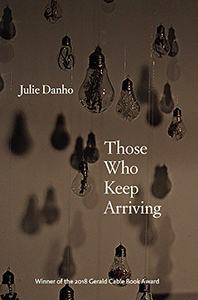
Those Who Keep Arriving

by Julie Danho
(Silverfish Review Press, 2020) 

Reviewed by Millie Tullis

Julie Danho’s Those Who Keep Arriving places intimate ekphrastic poems alongside poems that examine the bonds of family in the face of the reality of human violence. Danho zooms in and out with remarkable clarity, examining the details and imagining the processes of the art she encounters. The fragile bodies and powerful histories of family members, strangers, and the self are both studied and held in this expertly woven body of poems.

Danho’s collection opens with “Erased de Kooning,” which examines both a piece of art and an idea: “Robert Rauschenberg wanted to know if unmaking art / could make art.” The silent questions behind the poem and much of the collection may also be the most familiar and difficult ones: What is art? What is art for? What is the difference between art and idea? Between humans and their art? The speaker turns to the beloved, who is absent from, but intellectually imagined to be, studying the piece alongside the speaker. “If you were here, how you would / praise this, how we would argue over whether this was true, / over what, if anything, was.” But the speaker determines, “My love, Rauschenberg lied.” After studying the erased canvas, sprouting “de Kooning’s violet crayon” and seeing that “there are even eyes, / still looking” the speaker answers, “The idea, / yes. But how his arms must have ached afterwards.” After a month of Rauschenberg’s effortful unmaking, the canvas is changed, but it is not wiped clean.


While in “Erased de Kooning,” the speaker and her imagined love stand before a painting and an idea, in “Process Inspiration for the Final Piece,” a response to Carles Piera Claramunt’s installation from Inner Light: An Art and Therapy Experience at the End of Life, the speaker must enter and move through a room filled with lightbulbs in order to view the artwork. Instead of making light, the lightbulbs playfully interact with the observers-turned-participants, knocking “lightly against our faces, arms, even knees, / no matter how carefully we slip between. / Inside each, in place of the filament, // a feather.” While this room was once part of a Barcelona hospital, “where people came to be saved, or try // to be saved,” and lightbulbs were needed to provide light, now the peacock-feather-filled bulbs offer the participants something else:


now we stand here

amidst bulbs with no glow, no heat, useless

except for their glory, the way they bell


off our bodies, their feathers like tongues

either silent or ringing

at a register that’s too high to hear.


Danho’s poems are not afraid of this kind of wonder; these poems provide an understanding that is both ordinary, knocking against our bodies, and occasionally just beyond our reach. In “The Night Before Kindergarten,” the wonders coexist as the speaker and her husband share Saturn with their daughter through a telescope in their backyard. 


To her, the extraordinary 


is still ordinary, so why not planets shuttled to the eye 

by a tube tall as a sister? We’ve shut every light 

in the house to keep the night clean, to let her see


the show that’s all for her, the girl we made

then circled until she knew she was the sun.

Tomorrow, we’ll send her off to unlearn it, 


to discover, as we did, how small we are, 

how little we matter anywhere but here.


But Danho’s collection is not interested only in positions and perspectives that take place inside of art galleries and personal spaces—the family home, the pink-lead-paint bathroom, the couch, the bed, the night sky in the yard, or Saturn through the family telescope. These poems are as intensely political as they are intimate, as “It’s Terrible What’s Happening There” makes clear. This poem begins mid-sentence, continuing the title’s statement by drawing the details of a family name and a family’s food to the distancing term “There” in the title:


people say, if it comes up I’m Syrian 

when my daughter mentions her “Sito”

or I’m microwaving my kibbe at work.

And it is. But I don’t need to tell you.

You’ve heard the numbers of the dead. 


When the speaker’s great-grandparents “left Aleppo, / they carried their stories like gold / sewn inside clothes, but no one since / has pulled hard at the stitches.” The speaker’s daily horror, then, is not of a city “that bombs are skinning / down to concrete and bone,” but is instead “that of a woman who looks / at the sky and expects only blue—a luxury / my ancestors passed down to me.” Danho’s collection reminds that safety, or even just the illusion of safety, is a privilege of distance.


Horror and harm are measured and understood in terms of distance in this collection, not unlike the observer who shifts her perspective as she moves through an installation that is a room full of lightbulbs offering her something other than light. In “Distance” the speaker states, “it’s said that tragedy draws us closer, / yet we look for a rock to wedge between us”; when a woman is stabbed to death on the bus route the speaker takes to work, she interrogates our responses to such news. At the bus stop, “how quickly talk leapt / from shock to sympathy to did she / know him?” 


Did any of us

wake today and think we’d be dead

by today’s end? Maybe she did. After all,

it was her husband, which made us feel 

better. It’s always safer when someone 

is killed by someone they loved.


This brutal, simple diction rings true as it horrifies. Danho exposes our human instinct to distance ourselves from danger and pain and condemns this othering. In “The Museum of Broken Relationships,” she argues, “In the end, there’s no marvel / in how we suffer, only in how / we build skyscrapers out of rubble.” However, if this is the purpose of art, to build with what we have before us, experiencing art is never the experience itself. In “When the First Father Dies,” the first line answers the “When” of the title: “You’re glad it’s not your own.” Danho reminds us of the limitations of our imagination, 


But no matter the soft comforts you utter,

or the number of bodies you hold,


your turn will not be better. Seeing a mugging 

isn’t being mugged. Holding your breath 

isn’t a pillow held over your face.


Danho’s collection questions what spaces imagination and art allow us to access, and where we fail in the face of lived experience—in the face of both real love and real harm. In “Erased de Kooning,” she writes, “like much art, / its title tells me what to see.” Those Who Keep Arriving takes its title from “Early Marriage,” one of the book’s many love poems. Here, the speaker hypothesizes that if she catches “death’s wandering eye,” her love “won’t widow forever.” Still, she says, “death isn’t what I fear best. It’s the living / who must welcome those who keep arriving, / must open their arms to people who keep arriving.”